AF Obsolescence and Replacement
Klara and the SunAF Obsolescence and Replacement is the cycle in which newer Artificial Friends make older models vulnerable to being passed over or discarded. It appears first as a matter of specifications and retail choice, but the pattern widens into social unease: AFs fear being replaced by newer versions, while people who rely on them debate whether an AF is merely a reproducible mechanism or a being whose inwardness deserves protection.
Model Differences and the Market
At the store, obsolescence is made visible through model numbers. Manager presents Rex as a B2, a third-series AF, and recommends him as a companion likely to encourage a conscientious, studious attitude. The Mother recognizes the model and raises its reported solar-absorption problems in front of Rex. Manager responds that early reports were exaggerated and that the issue does not arise under normal light. The exchange shows how technical specifications enter a family’s purchasing decision: Rex can be described as an excellent fit and still be rejected because his model carries a known risk.
Klara herself intervenes in a later customer choice, saying she might not be the best option for a particular child. Manager is surprised, but concedes that Klara may be right and that the girl will be happy with a B3 boy. The moment complicates the logic of competition: Klara does not simply try to secure a home for herself, but recognizes a possible mismatch and accepts the newer model as the more suitable choice for that child.
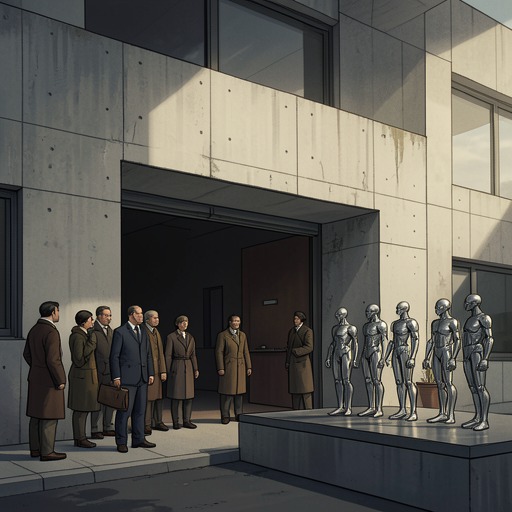
The store’s arrangement gives technical succession a physical form. When three new B3 boys arrive, two go into the window beneath a large new sign, while the third takes the front alcove. They are positioned prominently as fresh choices for customers. Rosa and Klara, by contrast, remain mid-store and are moved toward the Red Shelves after their turn in the window ends. Manager insists that any position can lead to a sale, and Rosa is eventually bought from the middle of the store. But the display still makes newness conspicuous: customers see the latest models set apart and advertised, while older stock must remain available beyond the most prominent spaces.
Replacement as a Social Fear
Klara’s observations outside the store extend this commercial pattern into AFs’ lives after purchase. She notices that more AFs pass on the RPO Building side than near the store, and that those who do approach on her side often cross away before reaching it. The few who pass tend to hurry and turn their faces aside. At first she wonders whether they are ashamed of having once lived in a shop. She also considers whether she and Rosa might someday feel embarrassed by their own store origins, but cannot imagine either of them rejecting Manager or the other AFs in that way.
A more troubling explanation occurs to her: the passing AFs may be afraid of the new models. Their children might see the newer AFs in the window and decide that it is time to throw away the older companion and replace it with one like them. The avoidance would then be less a sign of shame than a defensive attempt to keep children from seeing a potential successor. Klara cannot know whether this is what lies behind the behavior, and she does not tell Rosa. Instead, she turns their observations into a hopeful game, asking whether the AFs they see are happy with their children and homes.
Rosa readily reads visible affection as proof of happiness, celebrating pairs who laugh or smile together. Klara, more attentive to signs of conflict, sometimes recognizes that a child smiling at an AF is angry with him. She says nothing, allowing Rosa to keep her optimistic interpretation. This contrast shows how the possibility of replacement coexists with ordinary displays of companionship: an AF may appear secure in a family while the child’s feelings are less reassuring than the surface suggests.
The fear of becoming outdated also troubles AFs from within. Their official specifications guarantee that factors such as their position in a room cannot affect them, yet after several hours away from the Sun an AF may grow lethargic and worry that something is wrong. He may imagine that he has a defect peculiar to himself, and that, if others discover it, he will never find a home. The fear of rejection thus begins before replacement has actually happened: uncertain performance can feel like evidence that an AF is defective and unmarketable.
For that reason, the window matters beyond its status as a store display. Each AF is promised a turn there, and the position is described as a special honor representing the store to the outside. AFs also understand that appearing in the window increases their chance of being chosen. Beneath both explanations lies their shared belief that the Sun’s nourishment will be more abundant there. Rosa asks Klara whether being in the window will give them enough goodness never to run short again. Visibility, sales prospects, and physical nourishment converge in the same coveted place.
New Models and Uneasy Companions
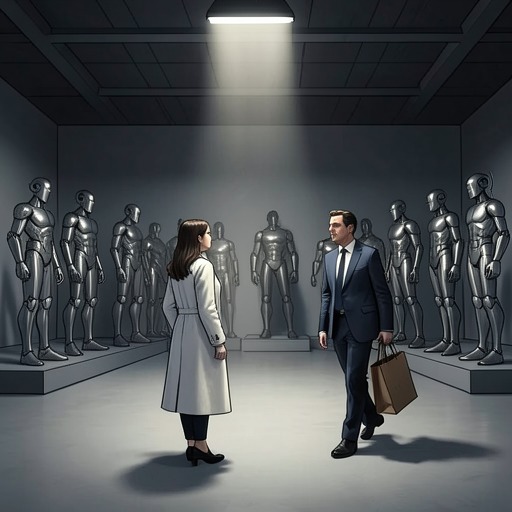
The arrival of newer AFs does not automatically produce a simple contrast between improved products and obsolete ones. After Rosa leaves, three new B3 boys are placed near two older boy AFs. The Glass Display Trolley separates them from Klara, but she can watch their behavior. At first, the older AFs welcome the newcomers and offer useful advice. Gradually, however, the B3s shift away from them, taking tiny steps or returning from a look through the window to a slightly different position.
After four days, Klara concludes that the B3s are deliberately making themselves look like a separate group when customers enter. They exchange sly looks and signals while the older AFs continue trying to help, apparently unaware of the distancing. The new models are said to have many improvements, but Klara doubts that such calculated behavior makes them good companions for the children who will choose them. Their arrival therefore brings more than a technical upgrade: it introduces an observed social hierarchy in which the newest AFs may distinguish themselves from their predecessors even before a child takes one home.
Rex’s questions about the Sun acquire a different meaning in this context. He continues smiling after the family leaves without choosing him, and shows no outward sadness. Klara later recalls his joke and infers that his questions about how much nourishment AFs could receive from the Sun had been on his mind for some time. His composure does not settle whether he feels rejection; it instead leaves the concern legible through the earlier questions. Across the store, the longing for the window and the anxiety about a model’s limitations reveal that a sale is not only a transaction but a hoped-for escape from uncertain status.
From Replaceable Mechanism to Protected Life
The replacement logic reaches beyond store sales into the question of whether one AF can continue a human life. When Klara completes Mr Capaldi’s questionnaire, its prompts include writing, shifting diagrams, layered sounds, and briefly appearing faces. Her responses grow from around twelve digits and symbols to more than a hundred as the questions become more complex. The test is treated as a means of measuring what she has learned about Josie and, in Mr Capaldi’s account, whether that knowledge can be used to inhabit a new Josie if the original dies.
Mr Capaldi distinguishes this proposal from simply training a substitute to imitate outward behavior. He says the new Josie is empty and asks Klara to become her, carrying forward what she has learned of the first Josie’s impulses and desires. He argues that no unique interior element would prevent such continuation and that the second Josie could be loved as the same person. The proposal recasts replacement as a solution to death, but it also makes the AF’s apparent ability to know someone deeply into a resource that can be transferred and used.
Years later, Mr Capaldi frames the study of AFs as a response to growing public concern. People, he says, accept that AF decisions and recommendations are often dependable but fear that they cannot understand how AFs think. His proposed answer is to open the black boxes, reverse-engineer them, and make their inner workings available for study. He asks Klara to volunteer because researchers have already opened other AFs and want to study many more. The argument turns the same uncertainty that once made an AF seem mysterious into a justification for invasive examination.
The Mother refuses. When Klara offers to help so long as it does not inconvenience Josie or her mother, the Mother says the request was not what they had discussed and rejects permission for Mr Capaldi to ask. She insists Klara deserves better than being opened for study and deserves her slow fade. That decision marks a sharp limit to the replacement ideal: even when AFs are publicly described as intelligible mechanisms and their inner workings as useful knowledge, Klara is not treated as an interchangeable object to be dismantled for research.
The Afterlife of the Display
Klara eventually sees her former store from the street, but its window no longer contains AFs or the Striped Sofa. In their place is a display of colored bottles and a sign advertising Recessed Lighting. The change is small and commercial, yet it gives the cycle a final, concrete image: the retail space that once made AF models visible has moved on to another product. The store’s disappearance from its former role mirrors the broader movement from one marketable category to the next.
At the Yard, Klara’s attention turns to the orderly rows of machinery, crates, and bundles. What first seemed untidy becomes, on closer inspection, a carefully arranged place, with long passages that allow each object to be seen individually. The account does not say that Klara is dismantled there, nor does it equate her directly with the discarded machinery. But her presence among objects marked by severed cables and dented panels places her in a world where things have reached an afterlife beyond use and display. Against that setting, the Mother’s choice of a slow fade rather than an invasive attempt to reproduce or inspect Klara acquires particular weight: replacement may define the surrounding system, but it does not exhaust the meanings of attachment, dignity, or a life’s ending.